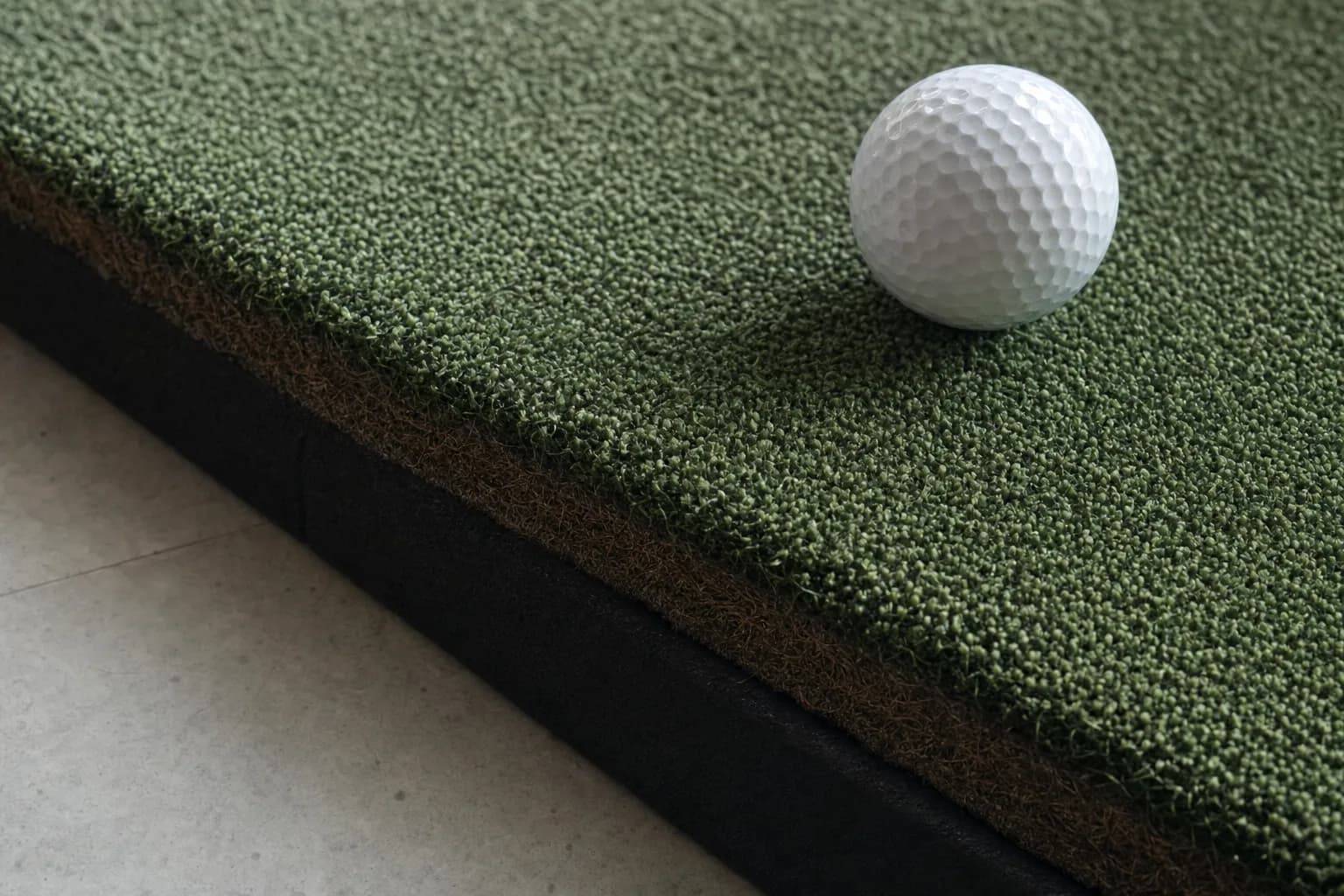

What a hitting mat has to get right
A hitting mat is the piece of simulator equipment your body notices most. Get it wrong and you feel it in your wrists and elbows within a few sessions. Get it right and you stop thinking about it. Four things decide which one you have.
- Joint protection. The base has to absorb the shock of a slightly fat shot instead of transferring it straight to your hands. A thin mat on concrete is the classic cause of golfer's and tennis elbow in home practice.
- Turf feel. A good surface lets the club pass through on a flush strike and gives you honest feedback on a fat or thin one. A cheap mat is either so dense it bounces the club (hiding your fat shots) or so sparse it feels nothing like grass.
- Stability. On a garage floor, a mat that slides an inch on every full swing is a constant, low-level annoyance and a safety issue.
- Launch monitor compatibility. A busy turf pattern or inconsistent pile height can make it harder for a camera-based launch monitor to isolate the ball cleanly. A simple, consistent surface under the ball position helps.
Is it harder to hit irons off a mat? Yes, and that is partly the point. A mat punishes a steep, ball-first strike less than turf does, so it can flatter a fat shot, but a quality mat still gives you the feedback. A hard, thin mat teaches you to sweep the ball to avoid the jarring, which is a swing fault you then take to the course.
How thick does a mat need to be?
For joint protection, the base matters more than the turf. Independent guidance converges on at least half an inch, around 12mm, of EVA foam or dense rubber under the turf as the floor for comfortable repeated practice, and more is better if you are hitting on concrete. The mats in this roundup range from a 15mm turf-and-foam build up to a 40mm multi-layer construction, and the thicker ones are noticeably kinder over a long session.
The premium end of the market, Fiberbuilt, TrueStrike, SIGPRO Softy, Country Club Elite, solves this differently and at three to eight times the price. Fiberbuilt uses an upside-down bristle-fibre surface that lets the clubhead pass through with almost no resistance. TrueStrike uses a silicone gel underlayer that deforms like a real divot. These are the mats that genuinely feel like turf and fully protect your joints, and if the budget is there they are worth it. This roundup covers the sub-$150 mats that get most of the way there.
Turf types, and how they read for a launch monitor
The surface you hit off is not just a feel question, it also affects how cleanly a camera-based launch monitor sees the ball.
- Dense nylon or polyethylene turf, the type on every mat in this roundup, gives a firm, consistent surface. It is the most launch-monitor-friendly because the pile height is even and the colour is uniform, so a camera can isolate a white ball against it without trouble.
- Bristle or fibre surfaces, as on Fiberbuilt, let the club pass through but can be visually busier. Some camera units want the ball placed on a specific part of the surface for the cleanest read.
- Dual-turf mats with a rough zone and a fairway zone, like the Fanshaw, let you practise different lies, but keep your launch monitor's ball position over the consistent fairway section, not the rough patch, for your tracked shots.
- Whatever the surface, hitting off a worn bald spot changes both the feel and the read. Rotate your hitting position or use a mat with multiple tee holes so the wear spreads.
For radar launch monitors the mat surface matters far less, since the unit reads the ball in flight behind you rather than photographing it on the turf. If you use radar, choose the mat purely on feel and joint protection.
What size mat you need
Every mat in this roundup is a 5-by-4-foot full-swing size, which is the right call for a simulator. A small square hitting pad is fine for a quick net session but it forces you to stand off the mat, so your feet are on a different surface and at a different height from the ball, which changes your lie and your balance.
- A 5-by-4 mat lets a right-handed and a left-handed golfer both set up on it, and gives you room to shift your hitting spot as it wears.
- If two people of different handedness share the bay, or you want a wider stance margin, some builders put a large sheet of gym turf down as a base and set the hitting mat on top, so your feet are always on turf.
- Do not go smaller to save money on a simulator. The mat is the surface you stand and swing on hundreds of times a session, and a cramped one is a daily annoyance.
Best overall value: Bearwill 31mm
The Bearwill is the mat I recommend most for a home simulator on a normal budget. It is a genuine multi-layer build, roughly 16mm of dense turf over a 15mm EVA base, and reviewers consistently single out its shock absorption and joint protection, specifically recommending it for golfers with sensitive wrists or elbows. The turf is described as firm and fairway-like rather than spongy, it has a commercial-grade durability rating, and the 5-by-4-foot footprint gives you room for your stance and footwork.
The one consistent caveat: like every mat at this price, it can shift on bare concrete during aggressive full swings, and a rubber pad or anti-slip underlay underneath fixes that. Its thickness also makes it a bit harder to roll up and store than a thin mat. Neither is a dealbreaker for a mat that reviewers repeatedly say punches above its price.
Two other things owners consistently mention in its favour: it lies flat quickly out of the box rather than fighting its shipping roll for a week, and the turf does not shed rubber crumb onto your clubface the way some cheaper mats do, which keeps practice cleaner. The commercial-grade durability rating means it is a mat you buy once for a home bay rather than replacing in a year.
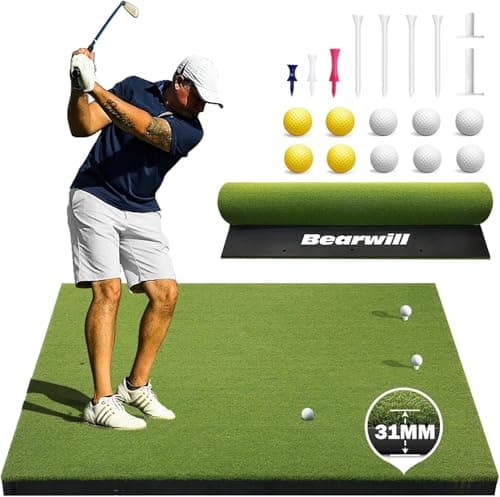
The mat I point most simulator builds toward. A real 31mm multi-layer build with genuine shock absorption, a firm fairway-like feel, and a full-swing footprint, at a mid-budget price. Put an anti-slip pad under it if your floor is bare concrete.
Best for driver and tee work: Fanshaw Premium Dual-Turf
The Fanshaw's standout feature is true tee insertion: you push a real wooden tee into the mat and it holds, which gives a far more realistic driver setup than a rubber tee sticking out of a hole. It is a thick 40mm-plus multi-layer construction with high-elasticity cushioning, it has dual-turf zones for fairway and rough lies plus a dedicated tee area, and reviewers report very high owner satisfaction and solid durability including through outdoor weather.
It shares the same concrete-slip caveat as the others and can arrive with a shipping crease that needs a day to flatten. If a big part of your practice is driver and you want a realistic tee, this is the pick.
Some versions of the Fanshaw add alignment aids and multi-surface stations for approach and path feedback, which reviewers find genuinely useful for structured practice rather than gimmicky. Owners also report it holding up to outdoor use and weather better than most mats at this price, so it works for a covered patio setup as well as an indoor bay. The dual-turf zones let you drop the ball on a rougher lie deliberately, which is a nice touch for approach practice, though keep your tracked launch monitor shots on the consistent fairway section.
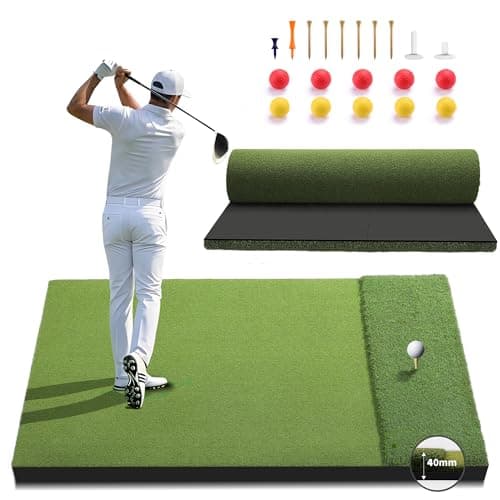
The one to get if you hit a lot of driver. Real wooden tees push into the surface and hold, the construction is thick and joint-friendly, and the dual-turf zones cover fairway and rough lies. Same advice on an anti-slip underlay for concrete.
Best for continuous practice: Ponsonbay with ball tray
The Ponsonbay integrates a ball tray into the mat itself, so you rake balls toward you without reaching for a separate bucket. It is a one-piece design, roughly an inch thick total with about 0.63 inch of turf over a 0.39 inch EVA base, with an anti-tear layer between them that reviewers flag as a durability feature not common at this price. Testers describe the strike feel as solid and realistic for irons and wedges.
The ball tray is functional rather than premium, and the mat needs an underlayment on smooth floors like the rest. For a garage setup where you want to hit balls in a steady rhythm without breaking to reload, the integrated tray earns its place.
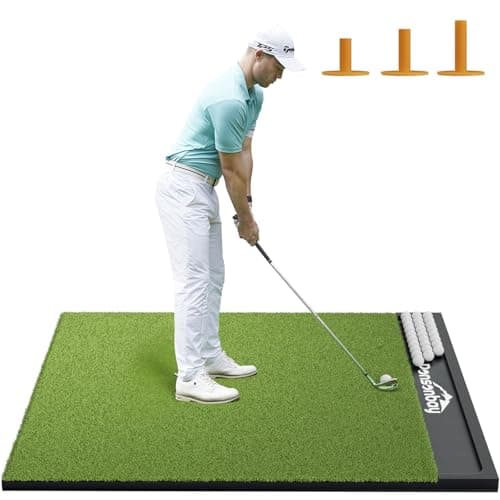
The pick for uninterrupted practice sessions. The built-in ball tray keeps balls within a rake's reach, the one-inch build with an anti-tear layer holds up, and the strike feel is solid for irons. The tray is basic but it works.
The budget option: GoSports Elite
The GoSports Elite is the most affordable mat here and a reasonable entry point for casual practice. Reviewers praise its stability, tight turf weave and multiple tee positions, and one year-long owner report says the turf held up. The recurring criticisms are that the foam base feels cheaper than the others, that it can shift after shots without securing, and that it produces some fine dust during swings.
For a beginner or occasional user it is fine. For a dedicated simulator you will hit thousands of balls into, the thicker Bearwill or Fanshaw is a better long-term joint investment for not much more money.
The dust point is worth taking seriously if the mat is going in a finished basement or a room with electronics. Some owners report fine turf debris being thrown up during swings, which settles on nearby surfaces. It eases as the mat breaks in, but a mat that sheds less, like the Bearwill, is the better neighbour for a tidy room. On a garage floor it does not matter.
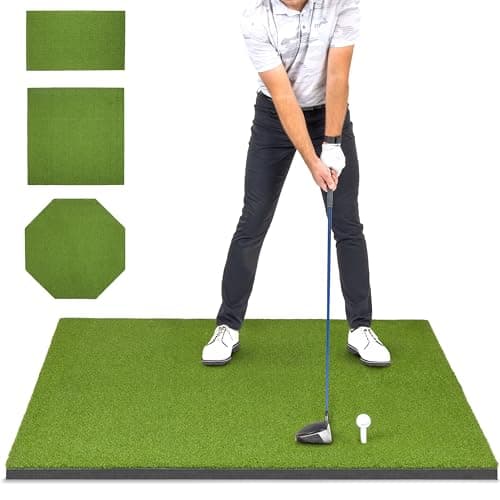
The entry point for casual or beginner practice. Stable, tight turf, multiple tee positions, lowest price here. The 15mm foam base is thinner than the others, so if you practice a lot or hit off concrete, size up to a thicker mat.
How the mats compare
| Mat | Stated build | Size | Standout feature | Best for |
|---|---|---|---|---|
| Bearwill 31mm | ~16mm turf over 15mm EVA | 5 x 4 ft | Shock absorption, fairway-like feel | Best all-round value |
| Fanshaw Premium Dual-Turf | 40mm-plus multi-layer | 5 x 4 ft | True wooden-tee insertion, dual turf zones | Driver and tee practice |
| Ponsonbay integrated | ~0.63in turf over 0.39in EVA, anti-tear layer | 5 x 4 ft | Built-in ball tray | Continuous, high-volume practice |
| GoSports Elite | 15mm turf-and-foam | 5 x 4 ft | Multiple tee positions, low price | Casual or beginner use |
Stated construction and standout feature for each mat, cross-checked against independent reviews. All four can slide on bare concrete without an anti-slip underlay. Check the live price on each product page.
Getting the setup right
- Put something under it on concrete. Every mat here can slide on a bare garage floor under a full swing. A rubber gym-floor tile, a piece of carpet, or a dedicated anti-slip pad stops it and adds a little more cushioning.
- Let it flatten. Thick mats ship rolled or folded and arrive with a crease. Lay it flat for a day, or in the sun, before you judge it.
- Check it is level. An uneven floor makes the edges unstable and changes your lie subtly from shot to shot.
- Mind your launch monitor's view. If you use a camera-based unit, keep the ball on a clean, consistent part of the surface and follow the unit's placement spec. A busy turf pattern right under the ball can add noise to the reading.
- Rotate the hitting area. You will wear a bald spot where you hit from. A mat with multiple tee positions, or one you can rotate, lasts longer.
How hitting mats wear out
Knowing how a mat fails tells you how to make it last and what to check on a used one.
- The hitting spot goes first. You strike from the same three-inch patch every session, and the turf there flattens and thins while the rest of the mat looks new. Multiple tee positions, or rotating the mat, spreads this out.
- The foam base compresses under the hitting spot too, so the mat gets subtly harder exactly where you hit. This is the real end-of-life signal on a budget mat, and it is why base thickness matters.
- Grommets and edges fray on mats that get rolled and moved often. A mat left flat in a bay avoids most of this.
- The backing can start to slide or curl if the mat is stored folded or in the heat. Store it flat or loosely rolled, never sharply folded.
On a used mat, look straight at the hitting area under a light. A visible worn patch or a spot that feels noticeably firmer than the rest means the mat is past its best regardless of how the rest looks.
Common questions
What is the most realistic golf hitting mat? At the premium end, Fiberbuilt and TrueStrike are the mats reviewers describe as genuinely turf-like, because they are built specifically to let the club pass through or to deform on impact. Among the sub-$150 mats here, the thicker multi-layer builds, the Bearwill and Fanshaw, feel closest to a firm fairway.
Is a golf hitting mat worth it? For a home simulator, yes, it is not optional. The question is how much to spend. A thicker mid-budget mat is worth it over the cheapest option because your wrists and elbows will thank you over thousands of swings. A premium mat is worth it if you practice heavily and the budget is there.
What is a good thickness for a golf hitting mat? At least half an inch, roughly 12mm, of foam or rubber base under the turf, and more if you hit on concrete. Total thickness of an inch or more, as on the thicker mats here, is comfortable for long sessions.
Will a mat damage my clubs? A quality mat with a proper turf surface will not. Very cheap, hard mats can scuff sole finishes over time. None of the mats here have that reputation in the owner reports.
Can I use these on concrete? Yes, all of them, but put an anti-slip and cushioning layer underneath. Concrete is the worst-case surface for both mat movement and joint shock, and a rubber underlay addresses both.
What are the disadvantages of a golf mat versus grass? A mat is more forgiving of a fat, ball-behind strike than turf, so it can hide that fault, and a hard mat can encourage a shallow, sweeping move to avoid the jarring. A good, thick mat with honest turf minimises both. It will never perfectly replicate every lie, which is why premium mats add rough zones and tee areas.
Does the turf feel like grass? On the sub-$150 mats, close on a flush strike, less so on a fat one. A dense turf over a thick foam base like the Bearwill's gets you a firm-fairway feel. It is not the same as the club shearing through real turf, which is what the premium bristle and gel mats are built to replicate.
Can I leave a mat set up permanently? Yes. A mat that stays flat in a dedicated bay lasts longer than one rolled and unrolled, and the thicker mats here are heavy enough to stay put once positioned, especially with an underlay. Just rotate the hitting spot occasionally so you do not wear through one patch.
Do I need a separate stance mat? Not with a 5-by-4 mat, since you stand on it. If you use a smaller hitting pad, you either stand on the hard floor, which is uncomfortable and changes your lie, or add a stance mat at the same height. It is simpler to buy the full-size mat.
Where to go from here
The reviews page lists every hitting mat I hold research on, with current pricing and stock. Decide how much joint protection and turf realism you need, then read the individual writeups.
Browse every golf hitting mat review
The piece of the setup your body notices most over a long session.